A vanilla Rails stack is all you need
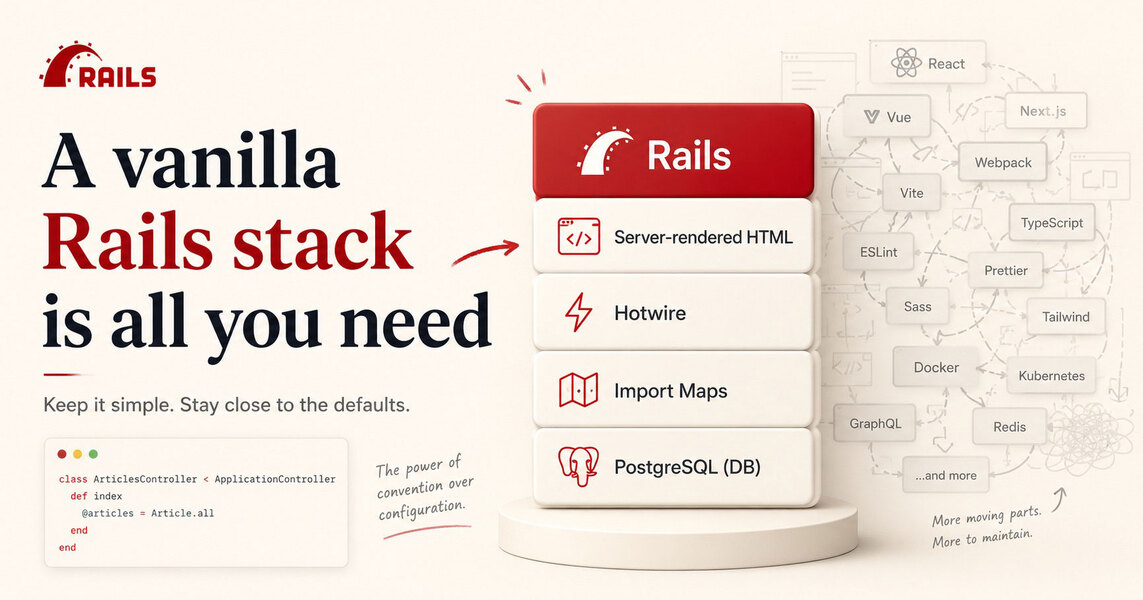
A Simple Rails Stack Goes a Long Way
Modern web development often feels like an arms race: more layers, more tools, more abstractions. But if you’re starting a new Rails app today, there’s a strong argument for doing the opposite.
Keep it simple. Stay close to the defaults. Let Rails do its job.
The Case for Staying Close to Rails
There’s a persistent idea that Rails alone isn’t enough—that “serious” applications eventually require extra architectural layers, frontend frameworks, or a constellation of dependencies.
But in practice, a well-used, mostly vanilla Rails stack can take you surprisingly far. The framework already includes solutions for routing, persistence, background jobs, realtime updates, and rendering. Adding more should be a deliberate decision, not a reflex.
The more you add, the more you carry:
- More dependencies to upgrade
- More concepts for the team to learn
- More moving parts to debug
- More long-term maintenance risk
New tools always make their benefits obvious. Their costs tend to show up later.
Default to Less
When starting out, treat every new dependency as something to justify—not assume.
- Keep your Gemfile as close to the default as possible
- Avoid pulling in frontend frameworks unless you truly need them
- Resist introducing service layers, command objects, or complex patterns by default
Rails already gives you a cohesive, integrated system. Splitting it apart prematurely often adds indirection without real benefit.
You Probably Don’t Need a Heavy Frontend
It’s tempting to reach for React, Vue, or a full SPA architecture. But for many applications, that’s solving problems you don’t yet have.
Server-rendered HTML is:
- Fast enough
- Easier to reason about
- Simpler to deploy
- More maintainable over time
Modern Rails tools like Hotwire let you build dynamic interfaces without abandoning the server-centric model. That means less JavaScript, fewer build steps, and a tighter feedback loop.
Embrace the Server Again
Rendering on the server isn’t a step backward—it’s a simplification.
Templates, helpers, and partials give you everything needed to build rich interfaces. They’re also approachable: designers and developers can collaborate directly in the same layer without bridging entirely separate systems.
You don’t need a JSON API just to render your own UI. Skip the extra hop unless it’s genuinely required.
Avoid the Build Step When You Can
A growing number of modern stacks rely heavily on bundling, compiling, and transforming assets. But that complexity is optional.
Instead:
- Use import maps for JavaScript
- Lean on modern browser capabilities
- Serve assets directly over HTTP/2
Shipping many small files is no longer a problem. Complexity in your toolchain often is.
Rethink Infrastructure Add-ons
It’s easy to assume you need a fleet of supporting services from day one.
But Rails increasingly provides built-in alternatives:
- Database-backed caching instead of external stores
- Built-in job processing instead of separate queues
- Native realtime features without extra infrastructure
Each external system you avoid is one less thing to operate, monitor, and scale.
Optimize for Longevity
A simpler stack has a powerful advantage: it ages well.
When you stay close to Rails conventions:
- New developers onboard faster
- Old knowledge remains relevant
- Upgrades are smoother
- The system stays understandable
Contrast that with stacks built from many independent pieces—each evolving on its own timeline.
Complexity Should Be Earned
None of this means “never add anything.” It means: don’t add it too early.
If a problem truly demands a new tool, you’ll know:
- You’ve hit real limitations
- The tradeoffs are clear
- The added complexity pays for itself
Until then, optimize for clarity and momentum.
A Simple Rule of Thumb
Start with Rails. Stay close to it as long as possible.
If your stack feels almost boring—minimal dependencies, server-rendered views, straightforward models—that’s not a weakness.
That’s a sign you’re letting the framework do what it was designed to do: help you build and ship software with less friction.
And most of the time, that’s more than enough.